
The universe holds many profound secrets. Among the most enduring is the rapid formation of supermassive black holes (SMBHs). These colossal entities, millions to billions of times the Sun’s mass, appeared surprisingly early in cosmic history. Astronomers have long grappled with how these ‘invisible leviathans’ grew so quickly.
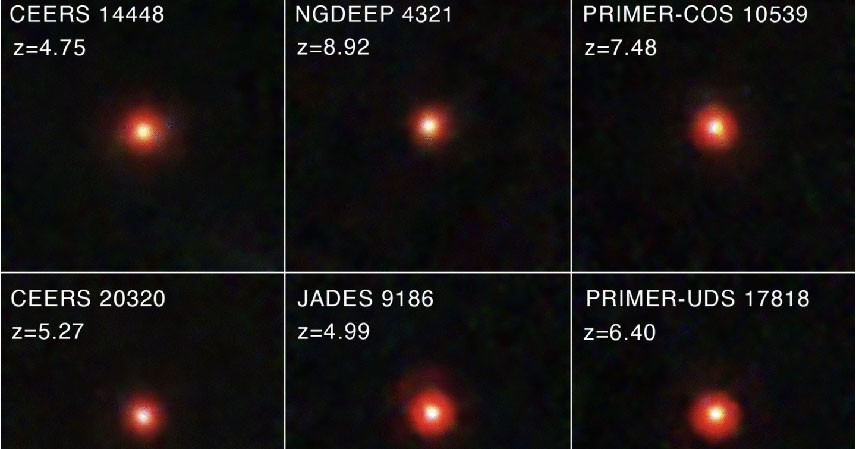
Adding a new layer to this cosmic puzzle, the James Webb Space Telescope (JWST) recently unveiled mysterious ‘little red dots.’ These tiny, distant scarlet orbs have sparked intense debate. However, a growing consensus suggests they are, in fact, nascent supermassive black holes. A new simulation offers a compelling bridge between these two great astronomical enigmas.
The Enduring Enigma of Early Supermassive Black Holes 🌌
Supermassive black holes reside at the heart of nearly every galaxy. Our own Milky Way hosts Sagittarius A*. These cosmic behemoths are not merely bystanders; they play a crucial role in galaxy evolution. Their presence so early in the universe, less than a billion years after the Big Bang, challenges established theories of stellar and galactic development.
Traditional models suggest black holes form from the collapse of massive stars. These ‘stellar-mass’ black holes then grow by accreting matter. They also merge with other black holes. However, this process is generally thought to be slow. It struggles to explain the rapid growth witnessed in the early universe. The sheer scale and speed of their formation remain a significant theoretical hurdle for astrophysicists.
Scientists have proposed various mechanisms to explain this rapid growth. These include the direct collapse of massive gas clouds. Another idea involves runaway stellar collisions in dense star clusters. Each hypothesis presents its own set of challenges. Each requires specific, extreme conditions to occur. The mystery has persisted for decades, fueling countless research efforts.
JWST’s Revelation: The ‘Little Red Dots’ ✨
The launch of the James Webb Space Telescope marked a new era in astronomy. Its unprecedented infrared capabilities allow us to peer further back in time. JWST’s images have revealed the universe as it was just hundreds of millions of years after its birth. It was during these deep field observations that the ‘little red dots’ first appeared.
These unexpected objects are extremely distant. Their light has been stretched by the universe’s expansion, appearing red. This phenomenon is known as redshift. Their ‘redness’ also suggests they are heavily obscured by dust. This obscuration is a tell-tale sign of intense activity. It implies rapid growth and powerful outflows.
Initially, their nature was hotly debated. Some speculated they could be unusual types of galaxies. Others considered them highly active star-forming regions. However, as JWST amassed a larger sample, the evidence shifted. Many now believe these dots are rapidly growing supermassive black holes. They are actively consuming surrounding gas and dust. This process makes them incredibly bright, despite their small apparent size.
The sheer number of these ‘red dots’ further strengthens this interpretation. Their prevalence in the early universe aligns perfectly with the need for a mechanism to explain early SMBH growth. They represent the crucial missing link. They show black holes in their early, voracious stages of development.
A New Simulation: Bridging the Cosmic Divide 🔬
The exciting prospect is that a new simulation could connect these two mysteries. Such a simulation would model the conditions of the early universe. It would explore how dense pockets of gas and dust could have led to the rapid formation of ‘seed’ black holes. These seeds would then grow quickly, becoming the ‘little red dots’ observed by JWST.
Simulations are powerful tools in astrophysics. They allow scientists to test theoretical models. They can evolve cosmic structures over billions of years. A successful simulation might demonstrate how these early black holes could accrete matter at extreme rates. It could also show how mergers with other black holes or dense gas clouds would contribute to their rapid mass gain. This would provide a concrete pathway for SMBH formation.
If the simulation accurately predicts the observed properties of the ‘little red dots,’ it would be a monumental achievement. It would confirm their identity as nascent SMBHs. More importantly, it would offer a robust explanation for the long-standing puzzle of early SMBH growth. This would revolutionize our understanding of cosmic evolution. It would shed light on how galaxies and their central black holes co-evolved from the very beginning.
Key Insights 🌟
- The rapid formation of supermassive black holes in the early universe has been a major astronomical mystery.
- The James Webb Space Telescope discovered numerous ‘little red dots,’ now largely believed to be rapidly growing supermassive black holes.
- A new simulation aims to explain how these early black holes formed and grew so quickly, potentially uniting these two cosmic puzzles.
- The findings could significantly advance our understanding of galaxy formation and the co-evolution of galaxies with their central black holes.
- These discoveries highlight the incredible power of new observational tools like JWST to challenge and refine our cosmological models.
The synergy between cutting-edge observations and sophisticated simulations is pushing the boundaries of human knowledge. The ‘little red dots’ are more than just distant specks of light. They are crucial clues. They hold the key to understanding the most powerful objects in the cosmos. They reveal the universe’s dramatic early chapters. As research continues, the mysteries of supermassive black holes are steadily unraveling, one red dot at a time.
Source: