
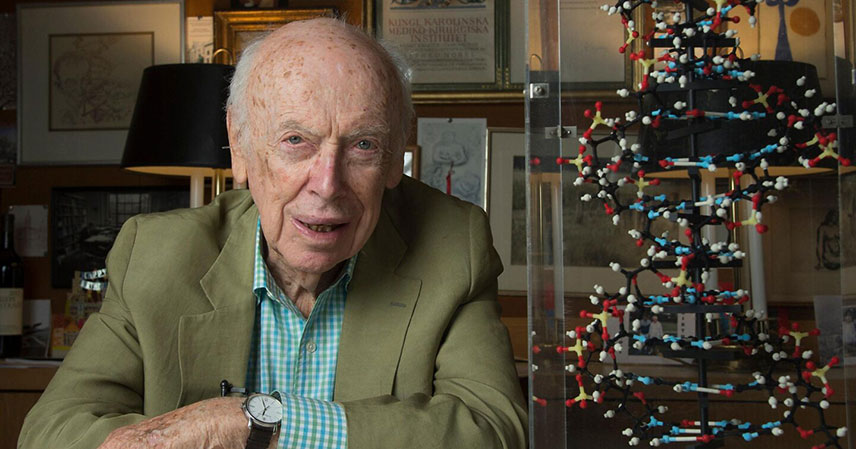
James Dewey Watson, a towering figure in 20th-century science, has passed away at the age of 97. His death marks the end of an era defined by both groundbreaking discovery and profound ethical debate. Watson was instrumental in revealing the double-helix structure of DNA. He also played a pivotal role in launching the ambitious Human Genome Project.
Yet, his legacy is deeply complicated. Watson became infamous for a series of racist, sexist, and otherwise offensive statements. His passing was confirmed by his son, Duncan, to The New York Times. Watson died on Thursday in a hospice in East Northport, New York. Cold Spring Harbor Laboratory also acknowledged his death, marking the end of a truly complex life.
The Revolutionary Discovery of DNA’s Structure 🧬
Born in Chicago in 1928, James Watson achieved scientific immortality at a remarkably young age. In 1953, at just 25, he collaborated with Francis Crick at England’s Cavendish laboratory. Together, they deciphered the molecular structure of DNA, the fundamental genetic blueprint for all life. This discovery was not merely academic. It unlocked unprecedented understanding of heredity, disease, and evolution. It laid the foundation for modern molecular biology and biotechnology.
Their groundbreaking work, however, did not occur in a vacuum. It relied heavily on the pioneering efforts of chemist and crystallographer Rosalind Franklin. Franklin worked at King’s College in London. Her meticulous X-ray diffraction images of DNA provided crucial clues. These images were indispensable to understanding the molecule’s distinctive twisted-ladder architecture. One image, in particular, known as Photo 51, proved absolutely vital. It provided the definitive evidence for the double-helix model.
The story of Franklin’s contribution is fraught with controversy. Watson and Crick obtained Photo 51 without Franklin’s knowledge or consent. Maurice Wilkins, a biophysicist and Franklin’s colleague, shared the image with them. This act remains a significant point of contention in scientific history. It highlights persistent issues of recognition and credit, especially for women in science. Franklin was not fully credited for her pivotal role during her lifetime. This continues to spark important discussions about ethical conduct in research.
Beyond the Helix: The Human Genome Project and Other Contributions 🔬
Watson’s scientific impact extended far beyond the initial DNA discovery. He was a driving force behind the conception and initiation of the Human Genome Project. This monumental international research effort aimed to map the entire human genome. Its goal was to sequence all 3 billion nucleotide base pairs. The project began in 1990 and was largely completed by 2003. It revolutionized our understanding of human biology and genetic diseases. It opened new avenues for diagnostics and therapies.
His leadership at institutions like Cold Spring Harbor Laboratory further solidified his influence. Watson served as its director and later its president. During his tenure, Cold Spring Harbor became a world-renowned center for molecular biology and genetics research. He fostered an environment of scientific inquiry and discovery. His vision helped shape the direction of genetic research for decades. His administrative and intellectual contributions were immense.
A Shadow of Controversy: Racism, Sexism, and Ethical Lapses ⚖️
Despite his immense scientific achievements, James Watson’s public statements cast a long, dark shadow over his legacy. Over the years, he made numerous deeply offensive comments. These remarks were widely condemned as racist, sexist, and homophobic. For example, he publicly speculated about genetic differences in intelligence between races. He also made derogatory comments about women in science.
These statements led to significant repercussions. He was stripped of honorary titles and faced widespread academic censure. Cold Spring Harbor Laboratory, the institution he once led, distanced itself from his views. They removed his emeritus titles. This controversy sparked critical discussions within the scientific community. It highlighted the tension between celebrating scientific genius and condemning personal prejudice. Can we separate the scientist from the person? Or does profound ethical failing diminish even the most brilliant minds?
Watson’s later life became a stark reminder. Even pioneers can harbor deeply troubling views. His words underscored the crucial importance of integrity and inclusivity in science. The scientific community grapples with his dual identity. It acknowledges his foundational contributions while unequivocally rejecting his hateful rhetoric. His story serves as a complex case study in scientific ethics.
Key Insights 💡
- The discovery of DNA’s double helix by Watson and Crick, profoundly informed by Rosalind Franklin’s work, revolutionized biology and medicine.
- Rosalind Franklin’s essential contribution, particularly Photo 51, was not adequately credited during her lifetime, sparking ongoing debates about ethics and recognition in science.
- James Watson was a driving force behind the Human Genome Project, demonstrating his continued impact on genetic research beyond his initial discovery.
- Watson’s legacy is irrevocably stained by his public expressions of racist and sexist views, posing a challenge to how the scientific community grapples with flawed heroes.
- His life underscores the critical need for scientists to uphold ethical standards and promote inclusivity, alongside intellectual rigor.
James Watson’s passing closes a chapter in scientific history. His life was a remarkable blend of extraordinary intellectual achievement and profound personal failing. He gave the world the key to understanding life itself. Yet, he also left behind a legacy marred by prejudice and controversy. His story reminds us of the power of discovery. It also highlights the enduring importance of human values and ethical conduct. Science demands not just brilliance, but also responsibility and respect.
Source: James Watson, who helped unravel DNA’s double-helix, has died