
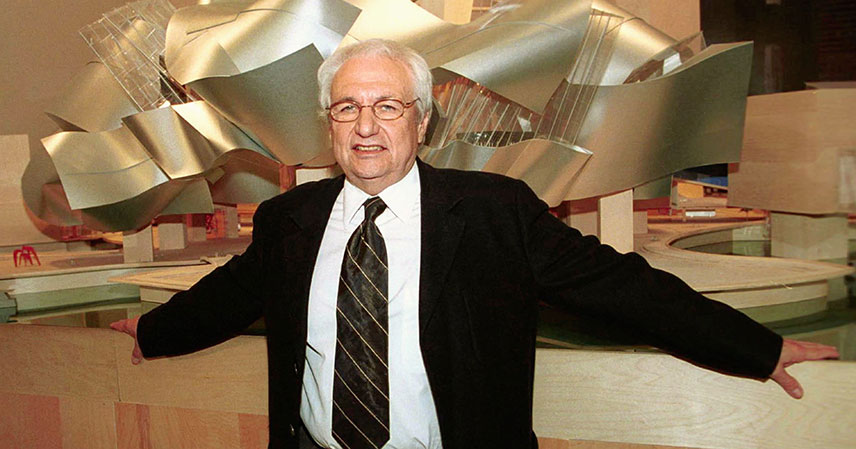
The world of architecture mourns the passing of Frank Gehry, a true visionary whose designs reshaped skylines and challenged conventional notions of form. Gehry, renowned for his distinctive and often whimsical structures, died at his Los Angeles home at the age of 96. His chief of staff confirmed his passing after a brief respiratory illness. His contributions to modern architecture are immeasurable.
Gehry’s influence extended far beyond mere construction. He was a pioneer in embracing computer-aided design, a tool that allowed him to bring his most ambitious and complex visions to life. His death marks the end of an era. Yet, his legacy will continue to inspire generations of architects and designers worldwide.
The Visionary Behind Deconstructivism 🏗️
Frank Gehry emerged as one of the most recognizable American architects since Frank Lloyd Wright. His style was immediately identifiable. It was characterized by exuberant bravura and arresting collisions of form. Gehry’s work often appeared to defy gravity and traditional geometry. He was a master of deconstructivism, an architectural movement that fragmented and reassembled elements.
His most celebrated creation, the Guggenheim Museum in Bilbao, stands as a testament to his genius. Opened in 1997, this fantastical, titanium-clad composition dramatically transformed the city. It garnered international acclaim. The museum single-handedly ushered in a new era of emotive and sculptural architecture. It became a global icon almost overnight.
Another iconic work, the Walt Disney Concert Hall in Los Angeles, further cemented his reputation. Its shimmering, stainless-steel curves captivate audiences. This structure, like many of his designs, created a vibrant public space. It offered an unparalleled acoustic experience. Gehry’s buildings were more than just structures; they were experiences.
A Legacy Forged in Titanium and Innovation 💡
Gehry’s architectural philosophy was deeply rooted in innovation. He did not merely design buildings. He sculpted them. His early adoption of advanced computer modeling was revolutionary. It allowed for the precise fabrication of his complex, non-linear forms. This technological embrace set him apart from many contemporaries.
His choice of materials was equally groundbreaking. Gehry famously utilized titanium, stainless steel, and corrugated metal. These materials, often industrial, were elevated to artistic mediums in his hands. He transformed mundane surfaces into dynamic, light-reflecting facades. This bold approach challenged material conventions. It opened new possibilities for architectural expression.
The impact of his innovative techniques resonated across the design world. Architects began to explore more organic and fluid forms. They were inspired by Gehry’s daring experiments. He proved that architecture could be both functional and profoundly artistic. His work encouraged a freer, more expressive approach to design. It pushed the boundaries of what was considered possible.
Beyond the Blueprint: Gehry’s Cultural Impact 🌍
Frank Gehry’s buildings were not just architectural marvels; they were powerful catalysts for urban revitalization. The “Bilbao Effect” is a prime example. The Guggenheim Museum’s presence single-handedly transformed a declining industrial city into a thriving cultural destination. This phenomenon demonstrated the immense power of iconic architecture.
His structures often became instant landmarks. They drew tourists and boosted local economies. They also sparked conversations about art, public space, and urban identity. Gehry believed that architecture should engage its surroundings. It should evoke strong emotions. His buildings certainly achieved this. They became cultural touchstones.
Gehry’s work transcended mere utility. It embodied a playful spirit and a deep understanding of human experience. He designed spaces that invited exploration and wonder. His legacy is not just in the buildings he left behind. It also lies in the profound way he changed how we perceive and interact with our built environment. He made architecture exciting again.
Key Insights from a Life in Design ✨
- Pioneering Computer-Aided Design: Gehry’s early and expert use of advanced software allowed for the realization of previously unimaginable architectural forms, setting a new standard for complexity and precision in design.
- Transformative Urban Impact: His iconic structures, such as the Guggenheim Bilbao, demonstrated architecture’s power to revitalize cities and create significant cultural and economic ‘effects’ globally.
- Bold Material Innovation: Gehry fearlessly experimented with unconventional materials like titanium and corrugated metal, elevating them to high art and inspiring a new generation of architects to push material boundaries.
- Challenging Conventional Forms: He consistently deconstructed traditional architectural elements, creating dynamic, sculptural buildings that redefined beauty and functionality in the modern age.
- Enduring Artistic Vision: Gehry’s unique aesthetic and philosophical approach ensured his buildings were not just structures but profound artistic statements, leaving an indelible mark on the global architectural landscape.
Frank Gehry’s passing leaves a void in the architectural world. However, his spirit will continue to thrive in the audacious curves and innovative forms of his iconic buildings. He taught us that architecture could be playful, powerful, and deeply moving. His vision will forever inspire those who dare to dream beyond the conventional. He truly was a titan of design.
Source: Frank Gehry, legendary Canadian-American architect, dies aged 96