
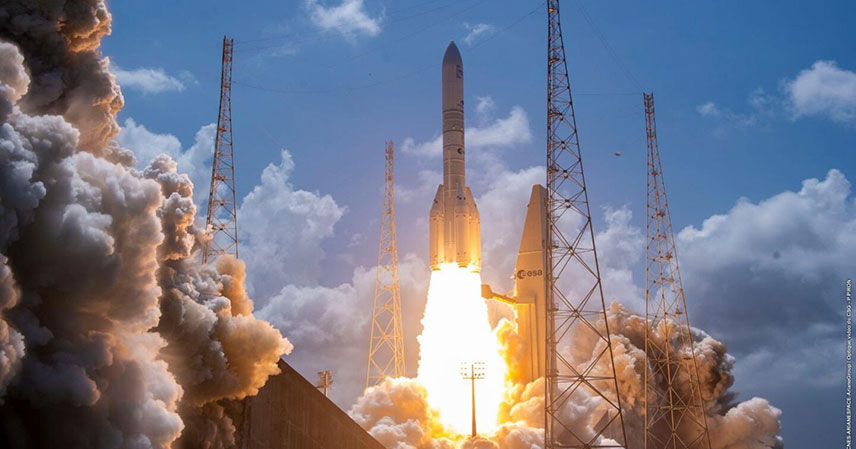
The European space industry achieved a significant milestone this past Thursday. The heavy version of its next-generation Ariane 6 rocket successfully completed its maiden flight. This launch marked a pivotal moment for Europe’s independent access to space. It also represented a crucial step forward for Amazon’s ambitious satellite broadband initiative, Project Kuiper.
Lifting off from the Guiana Space Center on the northeastern coast of South America, the powerful rocket carried 32 spacecraft into low-Earth orbit. This successful mission signals a new chapter for European launch capabilities. It firmly positions Ariane 6 as a vital player in the competitive global space market.
The Maiden Voyage of Ariane 6: A Triumph for European Space 🚀
The Ariane 6 rocket launched precisely at 11:45 am EST (16:45 UTC). It soared into a clear sky from its tropical launchpad. The rocket’s hydrogen-fueled main engine provided immense power. Four strap-on solid rocket boosters further amplified its thrust.
This particular configuration, known as Ariane 64, utilized the rocket’s full complement of four boosters. Collectively, the system generated an astounding 3.4 million pounds of thrust (15,400 kilonewtons). This incredible force propelled it northeastward over the Atlantic Ocean. Less than two hours after liftoff, the rocket’s upper stage meticulously released all 32 of Amazon’s satellites. They were placed into an on-target orbit at an altitude of 289 miles (465 kilometers).
The success of Ariane 6 is paramount for Europe. It secures the continent’s autonomous access to space. This capability is vital for both scientific missions and commercial endeavors. The Ariane 6 project aims to offer a more flexible and cost-effective alternative to its predecessor, Ariane 5. Its successful debut demonstrates Europe’s continued commitment to space exploration and innovation.
Powering Amazon’s Kuiper: A Crucial Step in Global Broadband Ambitions 📡
The primary payload for this historic launch was a batch of 32 satellites for Amazon’s Project Kuiper. Kuiper is Amazon’s ambitious initiative to deploy a vast constellation of satellites. Its goal is to provide high-speed, low-latency broadband internet globally. This service will specifically target unserved and underserved communities worldwide.
The successful deployment of these satellites is a major win for Amazon. It moves the company closer to realizing its vision of ubiquitous internet access. Project Kuiper is entering a highly competitive market. Rivals like SpaceX’s Starlink and OneWeb are already operational. Amazon’s strategy relies on securing reliable and frequent launch access. This first successful mission with Ariane 6 underscores the importance of diverse launch partnerships.
Amazon plans to launch thousands of Kuiper satellites in the coming years. This requires a robust and varied launch manifest. The Ariane 6 provides a crucial additional launch option. It complements Amazon’s existing agreements with other launch providers. This diversification mitigates risks and ensures the timely deployment of the entire constellation.
Strategic Implications and the Future of Commercial Spaceflight 🛰️
The Ariane 6 launch carries significant strategic implications. It reinforces Europe’s position in the global commercial space market. The rocket’s modular design and enhanced capabilities are designed for versatility. It can accommodate a wide range of missions, from scientific probes to large satellite constellations.
The success highlights a broader trend in the space industry. There is an increasing demand for heavy-lift capabilities. This demand is driven by the proliferation of mega-constellations. Companies are vying to establish global communication networks. Reliable and affordable access to orbit is thus more critical than ever.
Public-private partnerships are also becoming increasingly vital. The European Space Agency (ESA) and Arianespace’s collaboration with commercial clients like Amazon exemplifies this trend. This synergy fosters innovation and ensures the sustainability of space operations. As competition intensifies, Ariane 6’s operational cadence and cost-effectiveness will be key factors. They will determine its long-term success in this dynamic environment.
Key Insights from the Ariane 6 Launch ✨
- European Space Independence Secured: The successful maiden flight of Ariane 6 re-establishes Europe’s autonomous and reliable access to space, a critical national security and economic asset.
- Major Boost for Amazon’s Kuiper: The deployment of 32 Kuiper satellites significantly advances Amazon’s global broadband constellation, bringing it closer to commercial operation.
- Ariane 6’s Competitive Positioning: This launch demonstrates Ariane 6’s heavy-lift capabilities and reliability, enhancing its appeal in the fiercely competitive commercial launch market.
- Growing Demand for Satellite Broadband: The mission underscores the accelerating global demand for satellite-based internet services, driving innovation and investment in launch infrastructure.
In conclusion, the maiden flight of Europe’s Ariane 6 is more than just a successful rocket launch. It represents a powerful affirmation of European technological prowess. It also signals a significant leap forward for global connectivity via satellite. This dual triumph sets a promising trajectory for future space exploration and commercial ventures.
Source: When Amazon badly needed a ride, Europe’s Ariane 6 rocket delivered