
Miniaturization has long challenged robotics engineers. Electronics have seen dramatic size reductions. Yet, autonomous robots under one millimeter remained elusive. Small parts are fragile. Manufacturing them is difficult. Crucially, physics changes at this scale. Gravity and inertia diminish. Drag and viscosity become dominant forces.
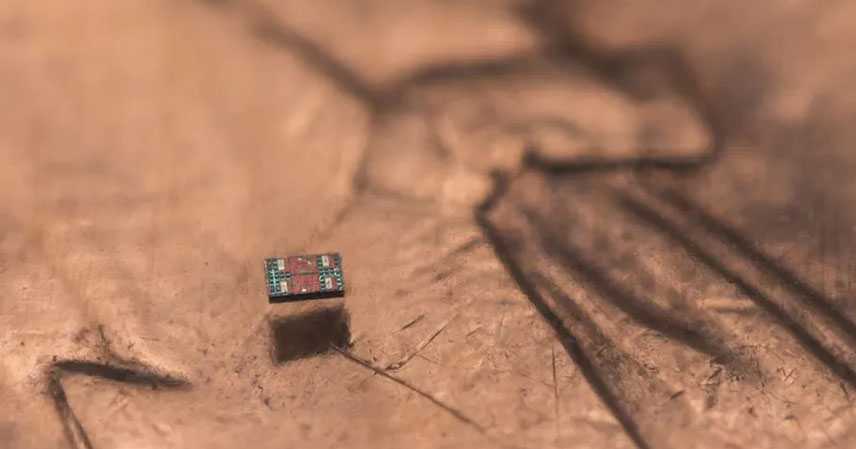
This long-standing barrier has finally been shattered. Researchers from the University of Pennsylvania and the University of Michigan made a breakthrough. They developed a new robot. It is smaller than a grain of salt. Its dimensions are 200 x 300 x 50 micrometers. The longest side is just 0.3 mm. This is well below the 1-millimeter threshold. This tiny robot senses its surroundings. It makes independent decisions. It also swims and moves in water.
This experimental robot is fully autonomous. It needs no external controls. Wires or magnetic fields are unnecessary. Its production cost is incredibly low. Each unit costs only one cent. Dr. Mark Miskin is a lead researcher. He is an assistant professor at the University of Pennsylvania. He stated, “We have succeeded in miniaturizing an autonomous robot to 1/10,000th the size of a conventional robot.” He added, “This opens up a whole new scale for programmable robots.” This achievement marks a new era.
The 40-Year Challenge: Why Miniaturization is Hard 🤔
The quest for microscopic robots faced many hurdles. Manufacturing tiny mechanical parts is complex. Arms and legs, for example, are inherently fragile. They are prone to breakage. Traditional fabrication struggles with such precision. Robustness at micro-scales is difficult to achieve. This physical challenge limited micro-robotics for decades.
The environment itself poses a major obstacle. In our world, gravity and inertia rule. Fish push water backward to move. This follows Newton’s third law. This works because water is relatively thin. At the microscopic level, water behaves differently. It becomes a thick, viscous medium. Imagine swimming through heavy tar. That is the micro-robot’s challenge.
Drag and viscosity become overwhelmingly dominant. Tiny mechanical parts cannot compete. Pushing against this “sludgy tar” is futile. The water simply resists movement. This fundamental physics shift prevented effective propulsion. It was the primary impediment to truly autonomous micro-robots.
The Electric Slide: A Paradigm Shift in Micro-Propulsion ⚡
The research team recognized these limitations. They pioneered a novel approach. Their robot generates an electric field. This field surrounds the robot. It gently pushes charged particles in the liquid. This method cleverly bypasses the viscosity problem. It represents a significant innovation.
The mechanism uses electro-osmosis. Charged particles move due to the electric field. They drag nearby water molecules. This creates a localized water current. The robot effectively creates its own moving “river.” It glides forward with efficiency. This works even in highly viscous environments. The robot itself does not push water. It creates a current around itself.
This propulsion system is a true breakthrough. It avoids delicate moving parts. These are hard to manufacture and operate. The robot’s autonomy is crucial. It senses its environment. It makes decisions independently. This capability is vital. Its low cost, one cent per unit, is also revolutionary. This makes the technology highly scalable. Dr. Miskin’s words ring true: “This opens up a whole new scale for programmable robots.”
Implications and Future Frontiers 🚀
Autonomous, sub-millimeter robots hold vast potential. They could transform medicine. Targeted drug delivery is one example. Robots might navigate bloodstreams. They could deliver medicine precisely to cancer cells. This would minimize side effects. Tiny surgeons could perform delicate internal procedures. Advanced diagnostics are also possible. They could detect diseases early.
Environmental monitoring will benefit greatly. Swarms of these robots could patrol water bodies. They could detect pollutants or harmful microbes. Their autonomy and low cost make them ideal. They offer widespread environmental surveillance. They could provide real-time water quality data. This would alert authorities to contamination faster.
The technology enables new scientific research. Scientists could explore microscopic biological systems. This would offer unprecedented detail. These robots might even assist in industry. Micro-assembly tasks are one application. Inspection of tiny components is another. Their versatility, autonomy, and low cost make them foundational. They will power a new generation of smart devices.
Swarm intelligence presents another exciting prospect. Thousands, or millions, of these robots could cooperate. They could achieve complex behaviors. They could solve problems beyond a single robot’s capability. Ethical considerations will arise. Regulation will be a topic of discussion. Yet, the immediate benefits promise to be transformative.
Key Insights from the Micro-Robot Breakthrough ✨
- Overcoming Fundamental Physics: Researchers successfully bypassed the dominant forces of drag and viscosity at the micro-scale, a long-standing challenge.
- Novel Electro-Osmotic Propulsion: An innovative system uses electric fields to generate localized water currents, propelling the robot without traditional mechanical parts.
- Full Autonomy and Cost-Efficiency: These robots are self-contained, capable of sensing and decision-making, and incredibly cheap to produce (1 cent per unit), enabling mass deployment.
- Broad Application Potential: The breakthrough unlocks significant possibilities in targeted medicine, environmental monitoring, micro-assembly, and fundamental biological research.
This achievement marks a pivotal moment in robotics. It showcases human ingenuity. It overcomes seemingly insurmountable physical barriers. The era of truly autonomous, microscopic machines is now here. It is no longer a distant dream. We stand on the edge of a future. These tiny robots could profoundly impact our health. They could improve our environment. They could enhance our understanding of the micro-world. The implications are vast. A future of innovative solutions, powered by these minuscule pioneers, awaits.
Source: This Autonomous Aquatic Robot Is Smaller Than a Grain of Salt