
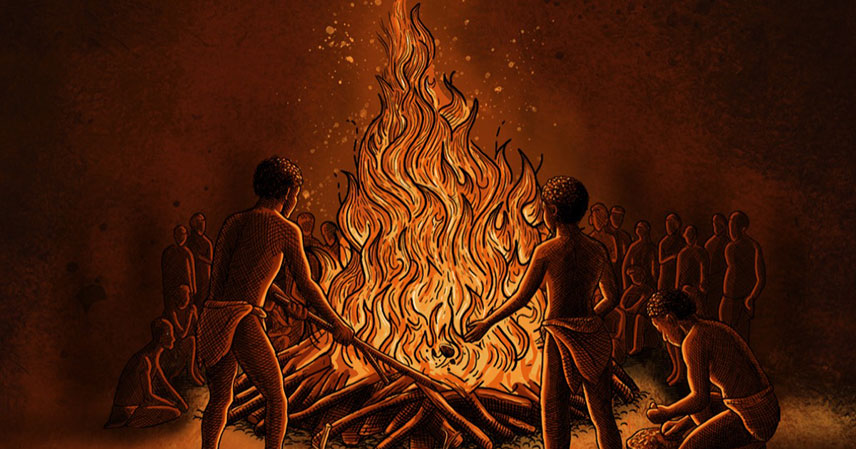
A groundbreaking discovery at the base of Mount Hora in Malawi is poised to redefine our understanding of ancient human rituals. Archaeologists have unearthed Africa’s oldest known cremation pyre. Radiocarbon testing places this remarkable site at approximately 9,500 years old. This find profoundly challenges previous assumptions about hunter-gatherer societies.
The discovery, detailed in a paper published in the journal Science Advances, sheds new light on group labor and complex ritualistic practices. It forces a significant rethinking of early human behavior in Africa. This ancient cremation site represents a pivotal moment in archaeological research.
Unearthing a Prehistoric Ritual: The Mount Hora Discovery 🌍
The Mount Hora site offers compelling evidence of a deliberate, organized cremation. Unlike earlier findings of burnt human remains, this discovery includes a clear pyre structure. This distinction is crucial. It confirms an intentional and sophisticated funerary practice.
The 9,500-year age places this event firmly in the early Holocene period. This was a time when human societies across the globe were adapting to changing environments. Hunter-gatherer communities were typically seen as nomadic and resource-constrained. Such an elaborate ritual challenges that simplistic view.
Previous evidence of cremation among hunter-gatherers is exceedingly rare, especially predating the mid-Holocene (5,000-7,000 years ago). The earliest known concentration of burnt human remains, found at Lake Mungo in Australia, dates back 40,000 years. However, a distinct pyre structure was absent there. This made it difficult to ascertain the exact nature of the burning.
The Malawi discovery provides concrete evidence. It points to a sophisticated understanding of fire and its use in ritual contexts. This level of organization suggests a community capable of significant communal effort. They invested substantial resources into honoring their dead.
Rethinking Ancient Societies: Labor, Community, and Belief Systems 🔥
Cremation is an inherently labor-intensive process. Building a pyre requires a considerable amount of firewood. It also demands sustained attention and communal effort. For ancient hunter-gatherer groups, this represented a substantial diversion of resources and time. These resources were vital for daily survival.
The commitment to such a demanding ritual speaks volumes. It suggests a strong sense of community cohesion. It also indicates a complex belief system. This system likely encompassed ideas about death, the afterlife, and the proper treatment of the deceased.
This discovery pushes back the timeline for complex funerary rites in Africa. It implies that early Holocene hunter-gatherers possessed advanced social structures. They could mobilize large groups for non-subsistence activities. This level of organization was previously attributed to later, more settled agricultural societies.
The Mount Hora pyre suggests a deep reverence for the deceased. It also points to established traditions passed down through generations. These traditions would have reinforced group identity. They also provided comfort and meaning in the face of mortality. This is a profound insight into the spiritual lives of our ancestors.
Such a discovery prompts comparisons with other ancient burial practices. For instance, the Vikings had cremation sites like Kalvestene in Denmark. Roman burial sites sometimes featured cremated remains covered with brick tiles. These examples, though much later, highlight the diverse human engagement with death rituals. The Malawi site, however, predates many of these known practices significantly. This antiquity offers a unique comparative perspective.
Global Echoes and Local Impact: A Broader Perspective 🗿
While cremation has been practiced globally across various cultures, the Malawi find stands out due to its antiquity and context. It predates many well-documented instances by millennia. This discovery challenges the notion that complex mortuary practices emerged solely in specific geographical regions or during particular societal stages.
The find at Mount Hora highlights Africa’s central role in the development of human cultural complexity. It demonstrates that advanced ritual behaviors were present on the continent much earlier than previously thought. This enriches the narrative of early human innovation and spiritual development.
Future research will undoubtedly delve deeper into the specifics of the Mount Hora community. Archaeologists will seek more evidence of their daily lives. They will also look for further insights into their societal structure. Understanding the full scope of this discovery will require interdisciplinary efforts. These efforts will combine archaeology, anthropology, and forensic analysis.
This site serves as a powerful reminder. Our understanding of ancient human societies is constantly evolving. Each new discovery refines our knowledge. It fills in the gaps in the vast tapestry of human history. The Mount Hora pyre is a testament to the enduring human quest for meaning and connection, even in the deepest past.
Key Insights 💡
- Africa’s oldest known cremation pyre, dating back 9,500 years, was discovered at Mount Hora, Malawi.
- This find provides concrete evidence of a deliberate, labor-intensive ritual among early Holocene hunter-gatherers.
- The discovery challenges previous assumptions about the social and ritualistic complexity of ancient nomadic societies.
- It suggests sophisticated communal organization and deep belief systems were present in Africa far earlier than thought.
- The Mount Hora site significantly advances our understanding of early human funerary practices globally.