
The universe is a vast tapestry of celestial wonders. Among its most captivating discoveries are exoplanets. These are worlds orbiting stars beyond our Sun. For decades, our search for these distant worlds focused on planets in tight, predictable orbits. Methods like the transit method detect a star’s brightness dip. Radial velocity methods find a star’s wobble. These techniques are effective for close-in planets. They allow astronomers to track their celestial dance repeatedly.
However, the cosmos holds secrets. Traditional methods often miss them. Enter microlensing, a powerful and unique phenomenon. It offers a glimpse into a different class of planetary bodies. This gravitational lensing technique helps us detect invisible planets. These include worlds wandering through interstellar space. They are untethered to any star. These are the enigmatic rogue planets. A recent discovery of a Saturn-sized world in an unexplored region is significant. It may rewrite our understanding of their mysterious origins.
The Dance of Light: Understanding Microlensing ✨
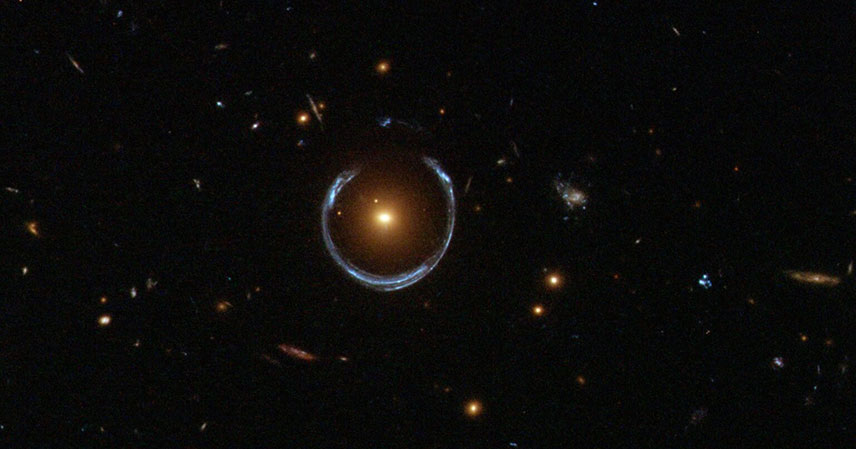
Microlensing is a fascinating astronomical phenomenon. It roots in Einstein’s theory of general relativity. It occurs when a celestial object passes precisely between Earth and a distant background star. The foreground object’s gravity acts as a cosmic magnifying glass. It bends the light from the background star. This bending distorts the star’s image. It causes the star to briefly brighten. This happens as the foreground object moves across our line of sight.
Microlensing is uniquely powerful. It detects planets regardless of their orbit. Other methods rely on repeated orbital observations. A microlensing event is a one-off occurrence. The lensing planet can be almost anywhere between the distant star and Earth. This characteristic makes it invaluable. It finds planets in very wide orbits. More intriguingly, it finds planets not bound to any star. It helps us find the true wanderers of the galaxy.
The brightening event’s duration and intensity provide crucial information. They tell us about the lensing object’s mass. A more massive object creates a stronger effect. It also lasts longer. This allows astronomers to infer unseen planets. We can estimate their approximate mass. This is true even if they emit no light. It showcases the subtle yet profound power of gravity.
Drifters of the Cosmos: The Enigma of Rogue Planets 🌌
Most identified planets orbit their parent stars. They formed from swirling disks of gas and dust. These disks surrounded young stars. We have even captured images of these protoplanetary disks. Some show clear evidence of planets forming within them. But how does a planet become a solitary traveler? How does it drift between star systems?
The existence of rogue planets (interstellar or free-floating planets) is a puzzle. Scientists propose two primary formation routes. The first suggests rogue planets are exiles. They formed within a planetary system. Then, violent gravitational interactions occurred. These were with other massive planets or the host star. The rogue planet was then violently ejected. Imagine a cosmic game of billiards. One ball is knocked clear off the table.
The second hypothesis is even more intriguing. Some rogue planets might form independently. They could coalesce in interstellar space. They would not form within a protoplanetary disk. They would not be gravitationally captured by a nascent star. This “solo formation” challenges our understanding. It suggests planets don’t always need a stellar parent to be born.
Understanding which route is more common has profound implications. It could reveal early planetary system dynamics. It could show the efficiency of planet formation. Rogue planets might vastly outnumber star-bound planets. They could be the most common planet type in the galaxy. Their study is therefore incredibly important. It provides a complete picture of planetary demographics.
Navigating the “Einstein Desert” 🔭
A recent discovery marks a significant milestone. A Saturn-sized planet was found via microlensing. Its location truly sets it apart. It resides in the “Einstein desert.” This term describes a specific range. In this range, microlensing events are harder to detect. It’s a region where the lensing signal is faint or fleeting. Discoveries here are exceptionally challenging.
Finding a planet of Saturn’s size in this “desert” is rare. It’s like finding a needle in a cosmic haystack. This suggests such planets might be more common. This holds true even where detection is difficult. The fortuitous orientation and precise measurements from the Gaia space telescope were crucial. Gaia maps the Milky Way with accuracy. It provided astrometric data. This data helped pinpoint the lensing object. It characterized its properties.
This discovery pushes our observational boundaries. It demonstrates the power of combining instruments. It also shows the strength of different techniques. More importantly, it offers critical data. This data aids models of planetary formation and evolution. The planet’s existence in the “Einstein desert” challenges assumptions. It questions where and how planets form and survive. It offers a new lens. Through it, we view the early, often tumultuous, lives of planetary systems.
Key Insights for the Future of Exoplanetology 🚀
- The discovery of a Saturn-sized rogue planet in the “Einstein desert” expands our understanding. It reveals more about planetary demographics. It also shows the potential abundance of free-floating worlds.
- Microlensing’s success, especially with Gaia data, is highlighted. It plays an indispensable role. It detects planets invisible to traditional methods. This broadens our search for extraterrestrial worlds.
- The finding provides crucial empirical data. This data refines theories on rogue planet formation. It helps distinguish ejection scenarios. It also clarifies independent formation pathways.
- Future research will target microlensing surveys. It will use advanced data analysis. This will uncover more elusive objects. It could reveal a hidden population of planets. These might outnumber those orbiting stars.
The vastness of space continues to surprise us. Each new discovery deepens our appreciation. A solitary planet wandering through the “Einstein desert” is profound. It shows the complex processes shaping the universe. Rogue planets were once curiosities. Now, they are tangible objects of study. Their existence compels us to rethink planetary definitions. It questions how common solitary worlds might be. As technology advances, we will unveil more cosmic wanderers. Each will have a story. It will be about the dynamic and chaotic birth of planetary systems.
Source: Researchers spot Saturn-sized planet in the “Einstein desert”